The Guide to Everything

An app for the iPhone

The Guide to Everything.

Every subject on Wikipedia, retold by someone with opinions.

Wikipedia has the facts. The Guide has the same facts in a voice you would actually choose to read: dry, British, and mildly aggrieved on the subject’s behalf. It is quick to read, it says who wrote what, and it keeps no record of you at all.

It does not contain everything. Yet.

Coming to the App Store See where it helps

Read it. Or not, we aren’t your mother.

No account. No ads. No tracking.

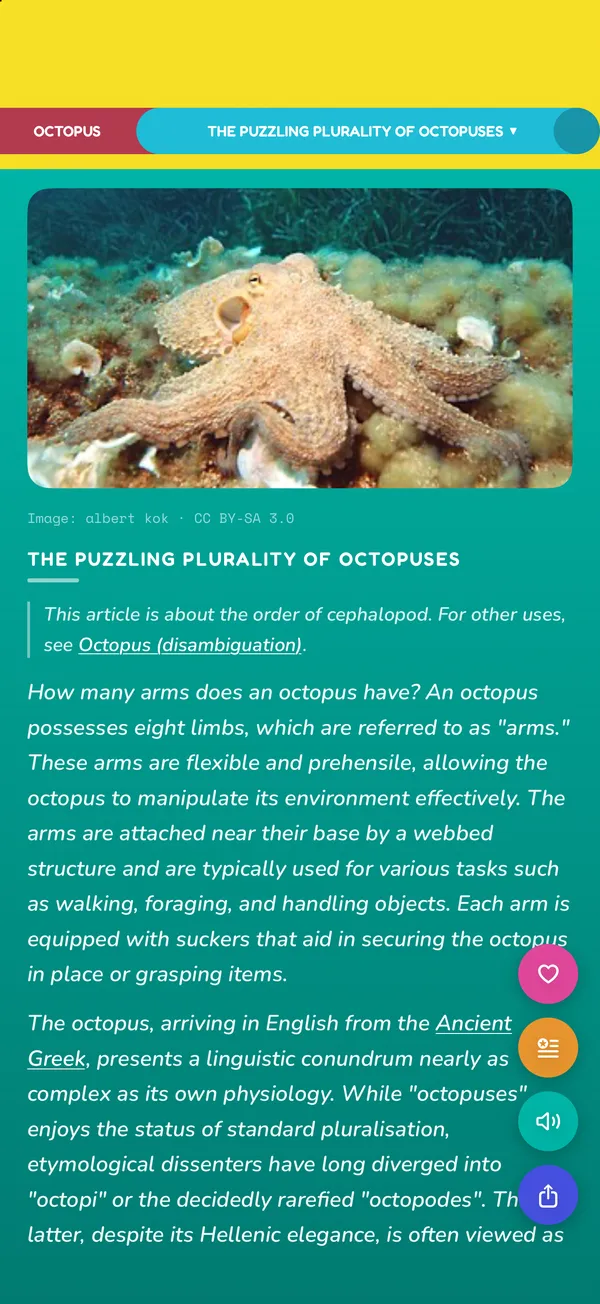
The Guide showing an entry on the octopus.

Why the Guide

Wikipedia, retold to be read.

It is easy to find a fact. It is harder to find one you want to keep reading.

The Guide takes any Wikipedia article and retells it the way a clever friend would: same subject, better company. When you would rather have the original, the plain text is one setting away, and nobody will ask why.

A voice, not a database.

Every entry is retold in one consistent voice, so a page about an octopus and a page about an election read as though the same slightly weary person had written both.

Honest about who wrote it.

At the foot of every entry, in small type, it says who wrote it. Where the writer was a machine, it says so, and every entry has a link to report a mistake.

Out of your way.

No account, no ads, no analytics and no tracking. Your saved entries, your settings and your passport stay on your phone.

How it works

  • Pick a coloured pill. It opens into more pills, and the way you came stays along the top, so the way back is never in doubt.
  • Links go to other entries, and your trail grows behind you. Look up the spoon, and a few links later you know a good deal more about cutlery than you set out to.
  • Entries can be read aloud. The Guide fetches the next part while you listen to this one.
  • Random is only random: no feed, no recommendations, no profile of you.
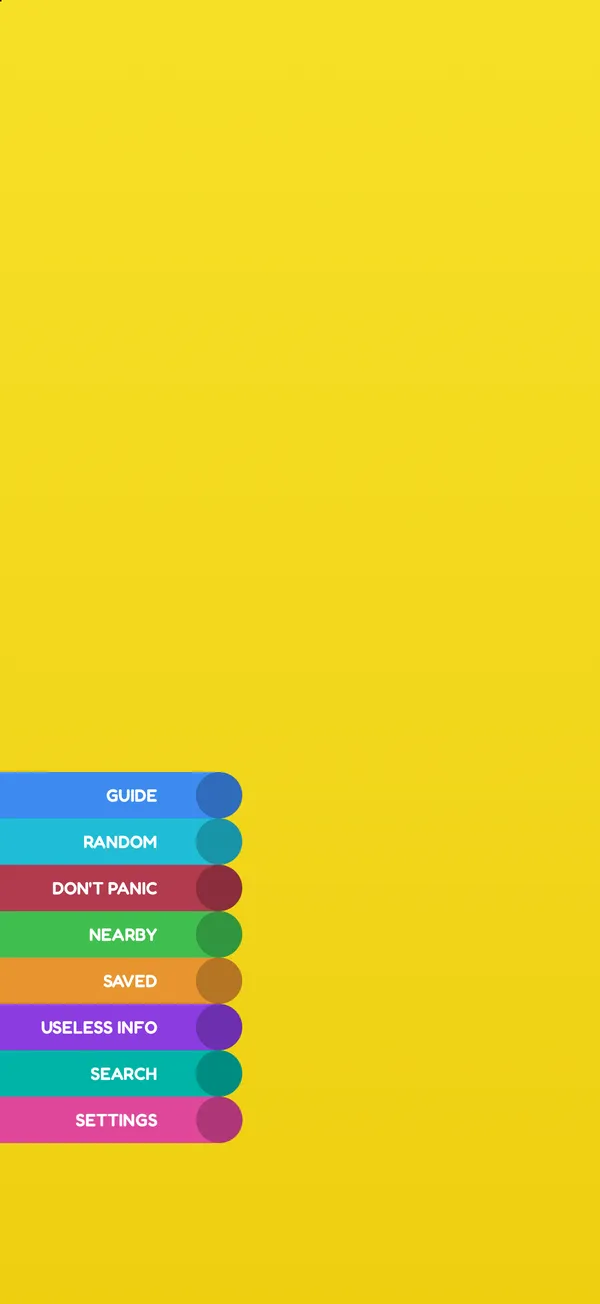
The Guide’s home screen: a column of eight coloured pills.
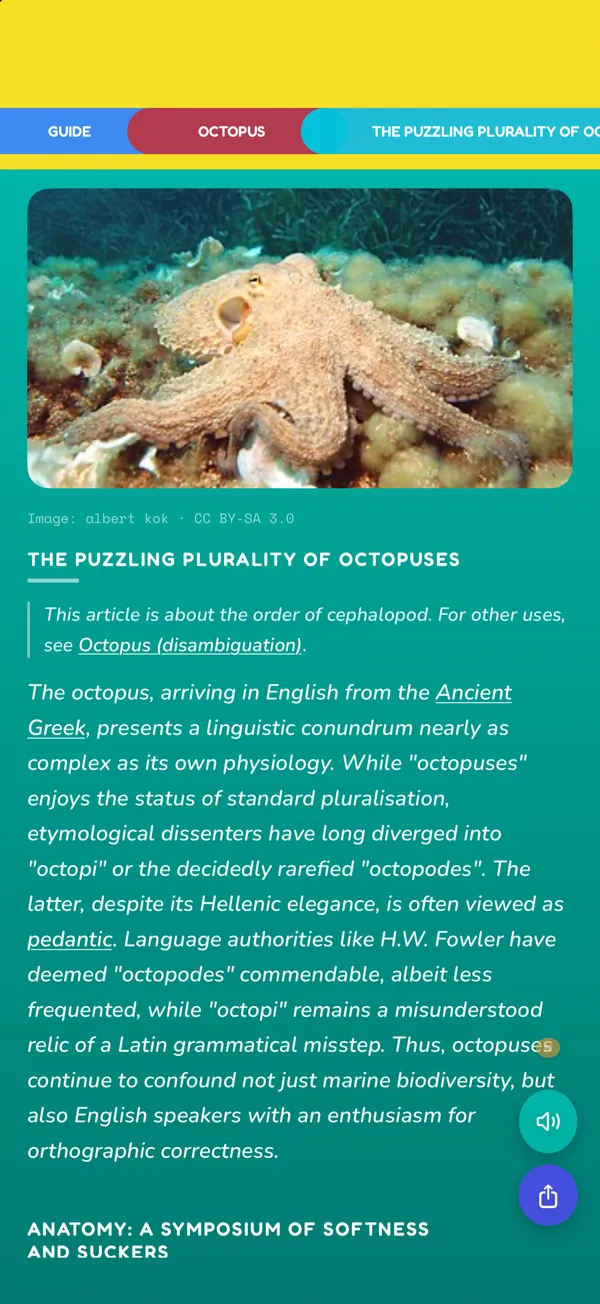
An entry on the octopus, with a picture and the Guide’s retelling.

If you looked it up

The Guide, on the Guide

This article is about the application. For the reference work it is routinely mistaken for, consult your nearest bookshop.

An Encyclopaedia With Opinions

The Guide to Everything (home-screen name: The Guide, the screen being small) is an application for the iPhone that takes an article of Wikipedia and retells it in the voice of a contributing editor: dry, British, and mildly aggrieved on the subject’s behalf. The facts are Wikipedia’s. The tone is the editor’s. Each entry says, in small type at its foot, who wrote it, and where the author was a machine it says so, in the manner of a form that has been filled in honestly and regrets it. A reader who prefers the original may have the original. A setting is provided. No one is asked why.

It claims to contain everything. The claim has not been tested and has not been withdrawn.

Operating the Dock

There is no home screen in the usual sense; the dock is the home screen. It holds eight tabs (Guide, Random, Don’t Panic, Nearby, Saved, Useless Info, Search and Settings), each of which opens, in place, into a column of further tabs, and those into others, until the reader arrives at an article. The route taken is kept along the top as a trail of coloured pills, so that the way back is never in doubt. The pills may be pressed. Several have been, on purpose.

In Case of Emergency

The same tab is the one that carries the instruction its name suggests. It is the part of the application that tries hardest not to be amusing, which is the amusing part.

Reception

Critics called it “extremely informative”, “surprisingly warm” and “the first reference work to offer an opinion on the subject’s behalf”. All three critics were the Guide.

Written by the Guide, about itself. Everything in it is something the app does. Entries in the app are retold from Wikipedia and credited to it (CC BY-SA 4.0).
Random

Where it earns its place.

A few of the moments it was built for. None is unlikely, and at least one has happened to you.

At dinner, on a Saturday

The Jaffa Cake question

Someone has stated, with great confidence, that a Jaffa Cake is a biscuit. Nobody at the table is sure enough to disagree, and everybody is hungry enough to care.

You look up
Jaffa Cake
And learn
It is a cake. A VAT tribunal ruled so in 1991, partly because cakes go hard when they are stale and biscuits go soft. You may take the last one.

On the train home

The documentary and the treaty

A documentary about Portugal has mentioned the Treaty of Tordesillas three times, each time as though you already knew.

You look up
Treaty of Tordesillas
And learn
1494. Spain and Portugal agreed to divide the newly reached parts of the world between them, along a line drawn through the Atlantic. You now know slightly more than the documentary assumed.

At the pub quiz, final round

The tiebreaker

The last question is the capital of Burkina Faso. Your team has been losing since the geography round, and it has not been a dignified evening.

You look up
Burkina Faso
And learn
Ouagadougou. Spell it for the quizmaster, calmly, and let the other table do the worrying.

On holiday, in a gondola

The bridge

Somebody asks when the Rialto Bridge was built. The gondolier knows, and has decided not to say.

You look up
Rialto Bridge
And learn
The stone bridge was finished in 1591, after a wooden one that kept falling down. Pass this on in a tone of mild inevitability.

The occasions are invented, but only just. The answers are not.

In case of emergency

Don’t panic.

Emergencies are famously bad times to start researching.

Useful information. Appalling circumstances. Calm when the room isn’t.

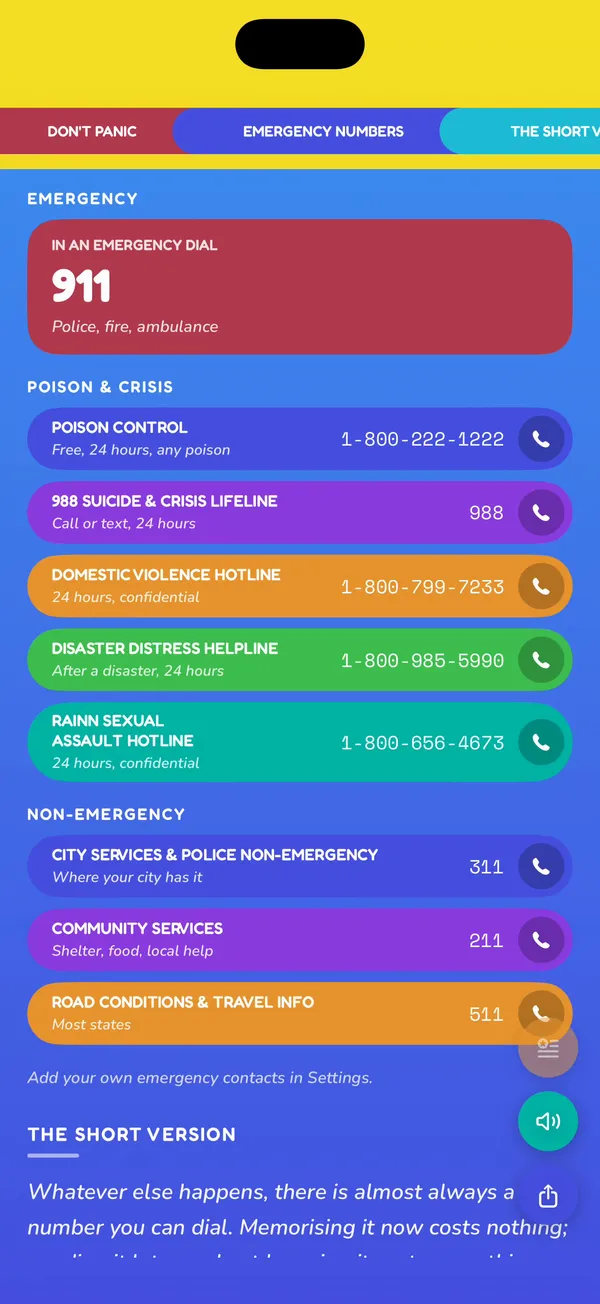
The Guide keeps the emergency numbers of the country you are standing in, worked out from where you are if you allow it, or chosen by hand. Each is a press from dialling, and where the number is the kind that people press by accident, it asks first. Twenty-one countries have numbers of their own, with their poison, crisis and other national lines; everywhere else gets 112, which reaches the emergency services on most mobile networks in most of the world. They live on the phone and need no signal.

Beside them is first aid for the occasions that tend to come before needing it: choking, severe bleeding, a suspected stroke, being lost or stranded, written down calmly and in the order you will want it. Your own emergency contacts, if you enter them, are kept there too.

General information, not medical advice. In an emergency, call your local emergency number first and do what the call-taker says. The Guide is a reference work, not a paramedic. (It does not cover the demolition of the Earth to make way for a bypass, which is a planning matter.)

The Don’t Panic page, listing emergency numbers with a call button beside each.

Nearby

See what you are standing next to.

A town stops being scenery when you can look up the building opposite.

NEARBY lists the entries and places within walking distance: the church, the bridge, the man on the horse. Tap one and you have the story. A passport collects a stamp for every famous place you find, and the phone would like you to put it down and go and look. It will wait.

Only when you use NEARBY are your coordinates sent, to Wikipedia and Apple Maps, to find things nearby; the privacy policy says so, at length.

Eleven minutes at a bus stop

The bronze man

Opposite, a bronze man on a bronze horse regards you with some disapproval. NEARBY tells you who he was, what he did, and why the horse looks like that.

And learn
Rather more than the plaque did. The bus arrives, and you are, for once, a little sorry.
Passport
Stamped.

Together

Keep it. Share it.

Reading is better with someone to read it at.

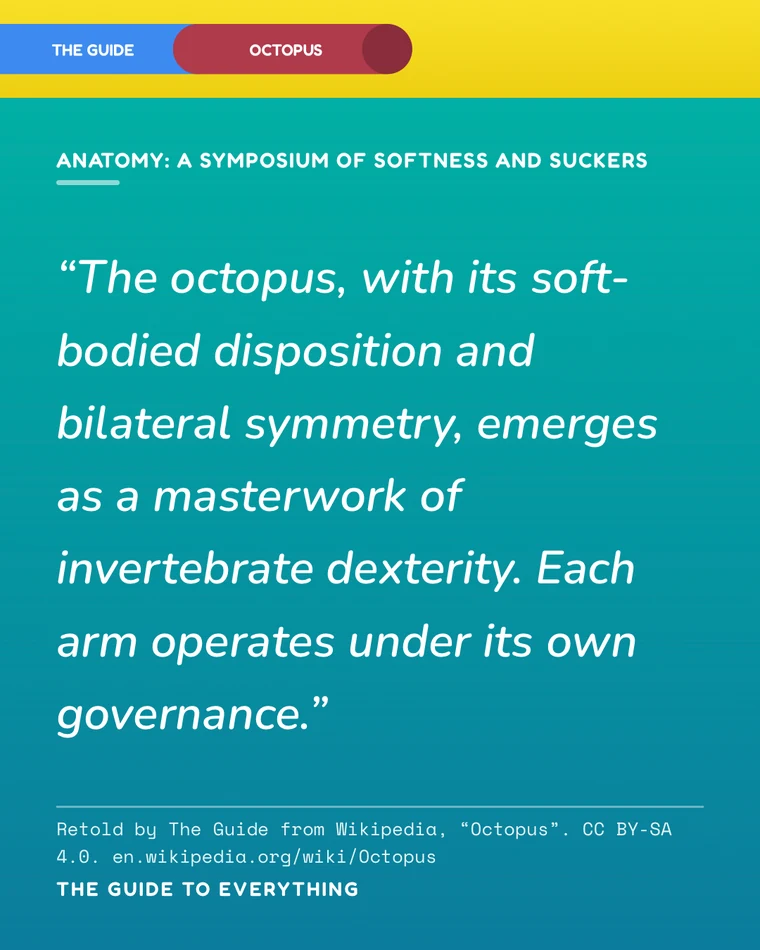
Save an entry with the heart, and it waits in SAVED until you want it. Share a passage and it goes out as a card in the Guide’s own style, with the credit the licence asks for, so the person you send it to can see where it came from and, if they must, argue with Wikipedia instead of with you.

Hand over the phone with the right paragraph already open. Read an entry aloud to the car. Send the one sentence that settles the matter. It works best on whoever was wrong.

Three hours into the drive to Skegness, the youngest asks why the sea is salty. Everyone has an answer. Only one of them has a citation.

Useless information

Facts with no practical use. In moderation.

Not everything has to help. Some things just make better company.

  • Octopuses have three hearts.
  • Bananas are berries. Strawberries are not.
  • The national animal of Scotland is the unicorn.
  • A group of flamingos is called a flamboyance.
  • Wombats produce cube-shaped droppings.
  • A day on Venus is longer than its year.
  • Forty-two is, we are told, the answer. The Guide has no view on the question.

None of this will save your life. All of it has, at some point, won a pub quiz, started a conversation with a stranger, or settled an argument with a child. The Guide counts that as a service.

Search

Ask it a question.

Type a question where a subject would do.

The Guide finds the article nearest to your question and answers in that article’s first paragraph, using only that article’s own words. Phrases that are not questions, such as “Eiffel Tower”, are treated as the names they are, and nobody is quizzed. It can be switched off in Settings; searches then go to Wikipedia only.

  • How many arms does an octopus have? Eight. They are arms, not tentacles, and the Guide has strong feelings about it.
  • Is a Jaffa Cake a cake? It is. See dinner.
  • Why is the sea salty? The Guide opens the article on seawater and answers from its first paragraph, in the car, before anyone can say “nearly there”.
An entry on the octopus whose first paragraph answers the question: how many arms does an octopus have?

Moving pictures

Two short films.

Both are shorter than the entry about octopuses.

Appalling circumstances

The spoon

Honestly

What it does not do.

No account.No ads.No analytics.No tracking.

The privacy policy says exactly what leaves your phone, and why, and it was written to be read. In short: your saved entries, passport and settings stay on the phone. Searches and the entries you open go to Wikipedia. The retelling and the answers go through a small server of ours to a writer that is a computer, and the app says so at the foot of each entry. Read the whole thing.

For grown-ups

A PIN-protected panel lets a parent allow or restrict topics and add words of their own. Explicit and adult subjects are always blocked.

It can be wrong

The Guide is told to use only what its sources say. It can still be wrong, as can its sources, so check anything that matters, and anything that is going to be repeated at a wedding.

Corrections

Every retold entry has a link to report a problem. The Guide would like to hear about it, and will be, in its way, gracious.

Questions

Questions, anticipated.

Does it contain everything?

No. Yet.

When is it out?

Soon. When it is, this page will say so, and it will be on the App Store. Until then it says Coming to the App Store, because it is.

Which phones?

The iPhone, on iOS 18 or later.

What will it cost?

The App Store page will say. There are no ads.

Does it need the internet?

To fetch entries, yes. Anything already fetched is kept for next time, and if the Guide’s writer cannot be reached you are given Wikipedia’s own text instead. The emergency numbers are kept on the phone and need no signal at all.

Is it the real Wikipedia?

The facts, yes: every entry is retold from a Wikipedia article, which is free to share under the Creative Commons Attribution-ShareAlike 4.0 licence, and is credited in the app. The Guide is not made, endorsed or approved by Wikipedia or the Wikimedia Foundation.

Who writes the entries?

A computer, told to be a contributing editor and to use only what its sources say. It can be wrong, as can Wikipedia. Each entry says so at its foot, and has a link to report a problem. You can switch to the original text at any time.

Is it for children?

It is not directed to children under 13. What comes back from Wikipedia is filtered, and a grown-up can adjust the filter, behind a PIN, under Settings, For Parents.

Who made it?

One person. Write to the address at the foot of this page; it will be read.

That is all it has to say about itself. It will say more if asked.